Latest Posts
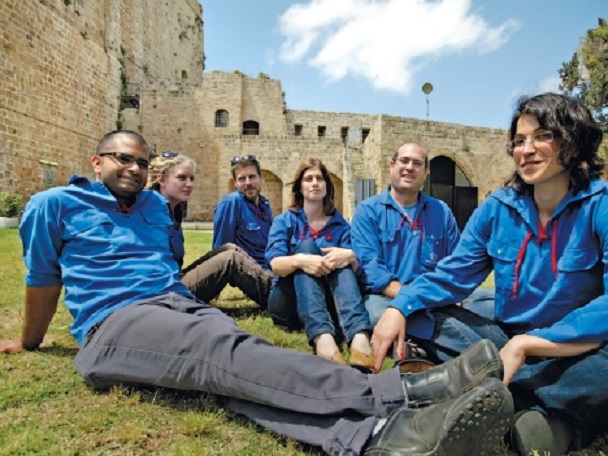

The New Kibbutzim: Case Study Overview of the Structure, Organization and Management of a Kibbutz of Kvutzot
From Communal Societies, vol. 32 no.2, 2012
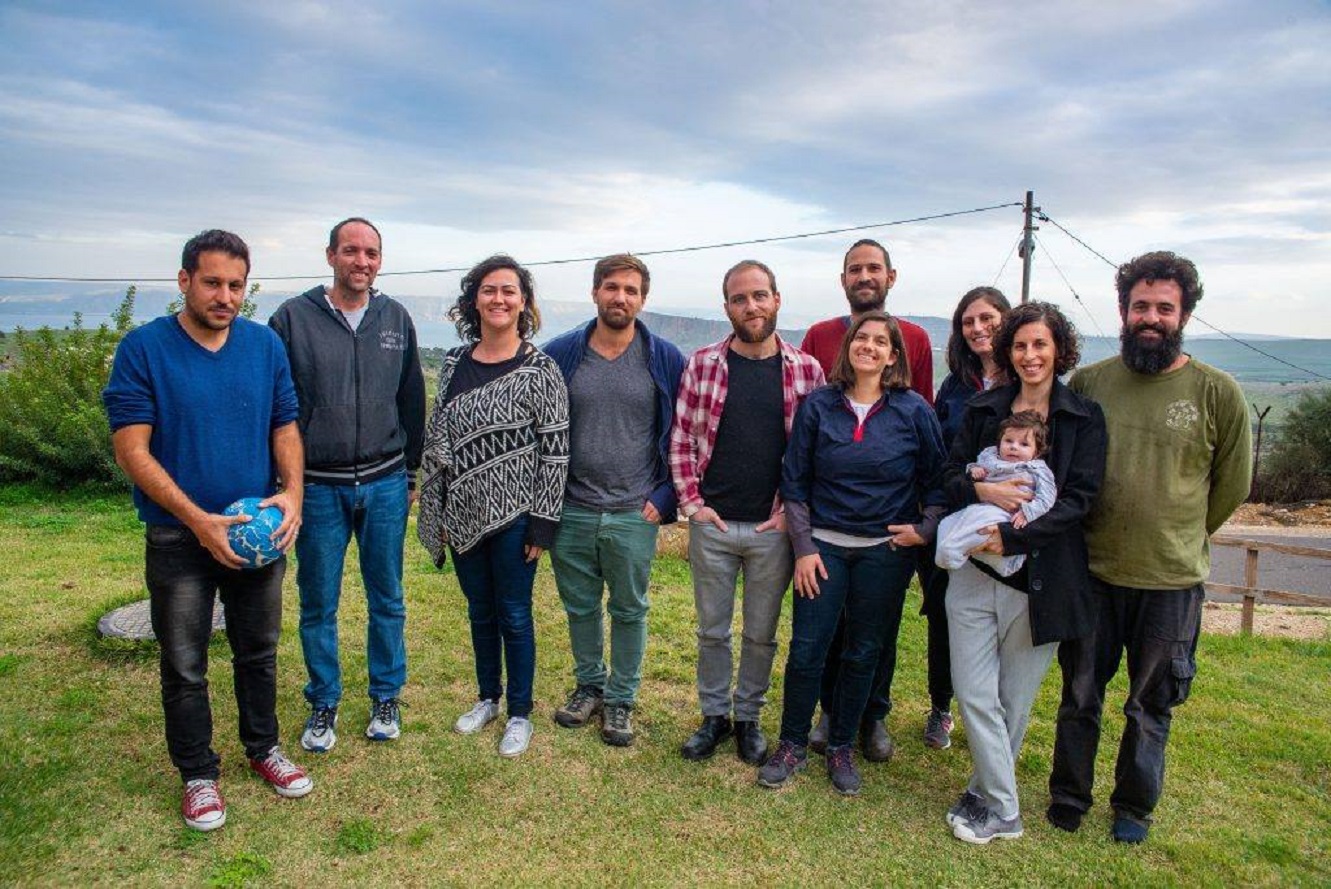
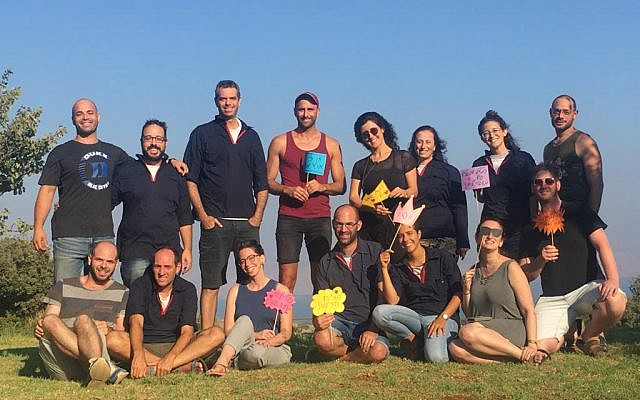
Located in a residential neighborhood of Migdal Ha’Emeq—a former development town in the North District of Israel—Kvutsat Yovel is one of a number of urban communes, or “kvutzot,” established in Israel by alumni of diaspora-based socialist Zionist youth movement Habonim Dror. 1 A product of debates in the youth movement during the late 1990s, echoing those of the previous decade in the Israeli youth movements that culminated in a shift away from rural kibbutz-building in favor of urban communalism, 2 Yovel began life in a Jerusalem suburb in January 1999. In 2002 the group moved to Migdal Ha’Emeq to join a cluster of similar kvutzot formed by alumni of Israeli youth movement HaMachanot HaOlim. This aggregation then consisted of five kvutzot with a combined membership of around forty-five, and it has since evolved into a “kibbutz of kvutzot,” comprising ten communes with a total of around one hundred adult members. As of 2010 the kibbutz has gone under the name of Mish’ol.3 Yovel itself has expanded in membership, currently consisting of three members from the United Kingdom, one from Australia, two from North America, and four former kibbutzniks from the Kvutzot HaBechira and Ha’noar Ha’oved (NOAL) youth movements in Israel, who completed the joining process in 2009.
Yovel exists as part of what is becoming known in Israel as the “new communal scene,” or “new kibbutz movement.” This “scene” comprises two broad streams of communalism: Tnuat Bogrim, or the “graduate movement” kvutzot, such as Yovel, formed by alumni of socialist Zionist youth movements, and a separate stream of non-movement affiliated communities, including the Urban Kibbutzim and “independent kvutzot.”4 The consolidation of individual kvutzot into “kibbutzim of kvutzot” has been the defining trend in the youth movement sector over the last decade. The following survey, summarizing research conducted in the form of ethnographic field studies of Yovel and Mish’ol between 2006 and 2011, offers some preliminary observations as to the character of these communities, sketching out an overview of their structure, organization, and lifestyle, and of the transformations they have undergone over the last ten years.5
- Social and Political Life
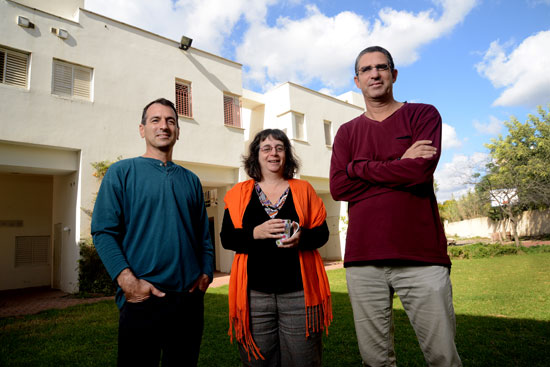
Kibbutz Mish’ol occupies around thirty rented spaces in Migdal Ha’Emeq and Nazareth Illit, homes ranging in size and type from single-family houses to apartment buildings. Members usually live in shared accommodation or in couples or families, the latter accounting for around 25 percent of the kibbutz’s total membership. A rented house in Migdal Ha’Emeq serves as a central meeting place, workspace, office-space, and library, the latter housing around a thousand books on education, Zionism, pioneering, and the kibbutz movement. For Yovel’s first five years in Migdal Ha’Emeq, the kvutza was spread across three living spaces—one large house and two apartments. In addition to providing living accommodations for individual members, each of these spaces also served a communal function. One space contained the kvutza dining room, another the library, and the third a communal space for group evenings, discussions, and other communal activities. The function of the space would be matched with the individual preferences of members, according to each individual’s level of comfort with people coming and going. For example, since the whole group uses the dining room every day, those living in the apartment with the dining room are those most comfortable with lots of coming and going. The apartment with the library would be living space for those who preferred a greater degree of privacy and quiet. Following a move to another neighborhood in Migdal Ha’Emeq in 2008, the physical character of the commune is broadly the same, other than that it now consists of five houses. A large house serves as the group’s communal space where group meals take place (Yovel eat together as a group at least twice a week, on erev kvutza [group evening] and on Friday night, though at most meals there are several members eating together), where the library is located and where erev kvutza is held. The building also houses an office, in addition to a number of members’ living space. Each of the kvutzot within the kibbutz generally follows this pattern.
Democracy
Each individual kvutza in the kibbutz has its own internal decision-making structures and its own time set aside for group meetings. In Yovel’s case, all internal kvutza decisions are made by consensus. While consensus decisionmaking is not employed in all the kvutzot in Mish’ol, Yovel considers it an imperative in that it obviates the risk of a majority vote that leaves a discontented minority. While no one specific consensus methodology has ever been used, according to one Yovelnik, “the important thing is that we’ve never been a voting kvutza. We’ve always talked things through and we’ve always been creative in our decision-making. In the history of this group we’ve only once not been able to reach a consensus decision—we ended up tossing a coin.” 6 This atmosphere of consensus and objective to give equal consideration to the views of each member obviates the need for formal authority structures, conducing to an environment in which the free flow and exchange of opinions typifies a culture of dialogue and keeps space open for the airing and interplay of a spectrum of views. While stressing a shared worldview facilitated by a common youth movement background, a plurality of opinions is welcomed and conflict not considered something to be avoided. Instead, it is encouraged, supported, explored, and resolved in a cooperative and creative manner. Such instances of polarization of opinion as arise from time to time are resolved through open dialogue, either to the point of consensus or toward mutual “agreement to disagree.”
Democratic procedures at the kibbutz level are structured so as to promote maximum decentralization in decision-making. The collective is sovereign, but, unlike traditional kibbutz democracy, this model does not involve a central General Assembly. Decision-making is instead dispersed across a wide range of centers. Committees, in which participation is voluntary and for the most part supplementary to members’ daily work schedule, are appointed to deal with all the various aspects of kibbutz life. Committees include work allocation, culture, economic planning, education, and every other area of the community’s day-to-day running. Functioning in a horizontal-participatory rather than top-down manner, these bodies operate differently than the committees on the mainstream kibbutzim. Minutiae vary depending on the issue under discussion, but the process by which decisions are made and policy formulated can be expressed generically as a kind of “ping-pong” dynamic. The committee assigned to deal with a given subject, composed of two representatives from each kvutza, meets every week for discussion of issues relating to its particular sphere of responsibility. The content of these meetings is determined by a second group, the committee coordinators, who draw up a proposal and bring it to those representatives, who then discuss it, amend it, discuss it, amend it, and so on. It then returns to the individual kvutzot, who discuss it in a group meeting, suggest amendments, and send it back to the committee. This process continues until a mutually agreeable decision is reached.
An illustration of this procedure can be seen in the makom (place) process of finding and deciding on a permanent location for the kibbutz.7 This process has four coordinators, each from a different kvutza, who meet on a weekly basis. Around these coordinators is a steering committee consisting of two individuals from each kvutza. This committee prepares the content of the discussion of the coordinators’ meetings. It is in this wider forum that the deliberation happens. Outside this forum, members of the steering committee also bring the discussions to the individual kvutzot, who hold their own discussions in their kvutza evening, and/or in kibbutz evenings where mixed groups meet for inter-kvutza discussion. The decision-making process thus consists of a total of five different circles, with power exercised from the outside in. The final decision is made neither by the central coordinating committee, nor by the steering committee, nor by the kvutza, nor by the mixed groups. The procedure remains fluid and dynamic, with ideas and suggestions bounced back and forth and open exchange of opinions expected. At any point in the deliberations, any individual kvutza can block the progress of a given motion. In almost all cases decisions are thus made without a show of hands or a ballot, resulting in what members consider to be a vibrant, flexible, and dynamic form of democracy. In the history of Mish’ol, there have been one or two exceptions where votes have been taken, but such instances are rare, discouraged, and not taken lightly.
This model is seen as actively subverting the centralization of power. With deliberative agency thus dispersed across the community, there is no one body that makes universally binding decisions. The system is not a fixed, immutable structure, nor is it based on any rigid constitution or institutionalized framework of norms. Smaller decisions are made on an ad hoc basis in the interests of expediency, and, as in the Second and Third Aliya kibbutzim, 8 the culture of dialogue ensures that ongoing informal deliberation is an everyday part of group life, with loosely formed, everyday group discussions among the diverse forums in which political activity takes place. The situation of the kibbutz handing down binding edicts concerning its members’ lives does not and, participants insist, cannot happen here. Whereas the original kibbutzim’s General Assembly vote determined whether an individual member could, for example, pursue a university education, here such a decision would be based on “discussion and open dialogue.” Individuals have the option to request the presence of another member from their kvutza for discussion and dialogue on certain subjects—such as the university scenario and the sphere of work allocation (historically another site of conflict between individual and collective)— with the kibbutz. This added safeguard is seen as ensuring that the decisionmaking process cannot become “the individual versus the kibbutz” but remains a kvutza discussion as well. To an outsider it may not be immediately clear how this might make any concrete difference, but members present it as an important mechanism inbuilt into the structural framework of the kibbutz of kvutzot by which the individual is protected against majoritarian tyranny. This mechanism, they argue, is illustrative of how the community structure is orientated toward subverting the classic alienation between the individual member and the kibbutz establishment via retention of the kvutza as the primary locus of decision-making and influence.
This structure effectively cancels the historical dichotomy between two competing models of communalism—kvutza and kibbutz—that emerged during the Second and Third Aliyot9 by combining the two types. While Yovel functions internally as a consensus-driven unit, the balance of participation and representation in kibbutz-level decision-making aims to provide a governance model capable of attaining consensus, or something approximating it, across a group as large as one hundred, via the mechanism of the small group (kvutza) within the larger structure (kibbutz). As in the established kibbutzim, the intimacy of social relations means that the direct exchange and airing of views and informal conflict resolution are everyday features of community life. This face-to-face interaction is deemed essential for the maintenance of direct democracy irrespective of the presence of official legislative and supervisory institutions. 10 The kibbutz of kvutzot views legitimacy as being contingent on active and continual public deliberation, rejecting majority voting as the central democratic institution and structuring its institutions in such a way as to ensure that open deliberation is the decisive factor. With maximal dispersion of agency across a horizontal network of interpenetrating discussion fora, they theoretically obviate dictatorial governance and individual alienation. All members recognize and respect each other’s deliberative capacity, and emphasis is placed on the open, transparent, and readily traceable deliberative process of each decision, in which all members of the community actively participated.
Economics
In the economic sphere, this system translates into a participatory model in which all members exercise equal influence in economic decision-making. The underlying values the system seeks to promote are equity, solidarity, and self-management. Committees and teams using self-managerial methods and participatory decision-making based on a multi-layered deliberative model, similar to that outlined above, guide the allocation of resources and consumption in an effort to operationalize these values. Remuneration is egalitarian, and through the communalization of finances, it is dissociated from individual effort or contribution. While there is evidence of movement toward economic diversification, the bulk of Mish’ol’s revenue comes from the state. Governmental subsidy is typical throughout the new communal scene. The communities’ rationale behind pressuring the state to finance their social projects is twofold: government funding counterbalances private economic interests, and it diverts public finances to areas—particularly education—deemed to have suffered as a result of successive measures to “roll back of the state” since the 1980s. For these reasons, the kibbutzim of kvutzot ascribe special significance, symbolic as well as practical, to their nonprofit organizations as their primary means of income. The nonprofits are considered both a pragmatic alternative to the privatization seen in the mainstream kibbutz federations, and consistent with a socialist Zionist outlook orientated toward the renewal of the Israeli welfare state. Mish’ol has four nonprofit organizations, the income from which is pooled into a central kibbutz fund. The largest of these, Amutah Tikkun, is chiefly engaged in fundraising for the social and educational projects the kibbutz operates in the local area. Revenues come in, primarily from the municipality and the Ministry of Education, on a project-by-project basis. A grant proposal will be drawn up, followed by a meeting with the municipality in which the proposed project will be discussed. Through Amutah Tikkun, members of each kvutza work alongside others from other groups in a communal work structure referred to as the meshek. While the kibbutz as a whole is dependent primarily on grants from the municipality, each individual kvutza also receives some revenues from the youth movements to which they are attached; no funding for the kibbutz’s educational and social projects comes from this source. A third source of revenue comes from a handful of members who work in external jobs in the surrounding society, unaffiliated with the kibbutz. Yovel has one member in outside employment, working in Haifa as a software developer. 11
Income from the nonprofit organizations and those members in outside employment is pooled by the kibbutz and each individual kvutza receives a sum of money for members’ living allowances, determined in accordance with kvutza membership numbers. Until 2007 each kvutza retained its own economic independence in that each group received the money from the central pool as well as any income from group members working an outside job. Kvutzot would therefore have different levels of income. As of 2008, as part of the ongoing process of consolidating the kvutzot into the kibbutz, an individual cannot be a member of a kvutza but not part of the kibbutz. Therefore, individual members no longer have the option to be part of the kibbutz without being part of its economic cooperation structure. Yovel had previously been a separate financial entity due to its financial cooperation with the other Habonim Dror kvutzot in other parts of the country, but in September 2008 the group completed the process of joining the kibbutz financially. In practice this means that while the kvutza retains its communal account, the kibbutz decides the sum of money that goes into that account.
The treasurers of each kvutza convene on a weekly basis to discuss kvutza- and kibbutz-level financial issues. Internally, each kvutza retains its own preferred system of kupah (loosely, “common fund”) with varying levels of communalism in the management of personal finances. As noted above, Yovel opts to pool its members’ incomes into a communal account. Each member has an automated teller machine (ATM) card for that account and may withdraw money at his or her own discretion. The group’s choice of this form of economic communalism, their chosen arrangement since Yovel’s establishment as a kvutza in 1999, stemmed, one member recalls, from “the desire to think in terms of ‘we’ rather than of ‘I.’” Explaining the initial decision, she continues: “it wasn’t like ‘ok, we know each other really well, we like each other, let’s open up a communal account.’ The desire came first; the kupah was a system we decided to put in place to help us achieve that, to help us think as ‘we.’” While the famous asceticism of the original kibbutzim is not a characteristic of the new kibbutz ethic, full economic cooperation of this kind conduces to an anti-consumerist culture, individual self-discipline, and an overall atmosphere of responsibility within the group. The push and pull between members, public opinion, ideological cohesion and social consciousness are the stabilizers of economic life, the need for formal enforcement mechanisms negated by social pressures and the intimacy of personal relationships. These factors acting in combination ensure voluntary adherence to the kvutza’s collectively understood norms.
Learning
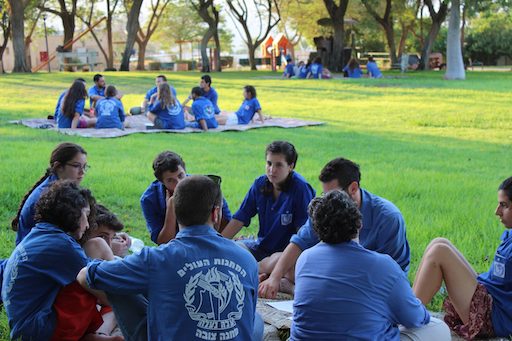
The kibbutz of kvutzot is organized in many different respects around educational activity. The numerous and diverse formats of communal learning sessions around which the communal timetable is formed are deemed vital in developing a shared language and defining the community’s semiotic vocabulary. Each kvutza has a weekly group evening (erev kvutza), during which members discuss a prepared topic. This might relate to issues arising from one of the kibbutz committees, social or political issues, or text-based study. Similar “learning” is held on the Jewish festivals, Shabbat, kvutza weekends away, and various other fora. A common youth movement background provides the template, format, and dynamic of the communal learning sessions with different modes of discussion and uses of texts, poetry, games, and other media drawn largely from the youth movement. Communal study also takes place as a kibbutz, principally in monthly kibbutz evenings, either in mixed groups or pairs of “organic” groups, and in a fortnightly kibbutz learning forum, in which three or four kvutzot meet and “learn together,” The monthly and fortnightly studies broaden internal kvutza discussions so as to bring them to the wider kibbutz. Similarly, Beit HaYotzer (“creative home”) for interested members of any kvutza meets on Friday mornings, further ensuring the maintenance of constant dialogue and mutual learning between the various groups.
Members’ reference and identification group is not only the one with which they have direct day-to-day contact within the kibbutz, but also extends to their peer group of the same age and background living on other kvutzot, as well as former members of the community and/or movement. Heavy emphasis is placed on academic study, and the whole group may join in to enable a member to study. Academic studies usually take place in Labour and Kibbutz Movement institutions, such as Beit Berl and the Tel Aviv and Oranim Kibbutz Academic Colleges, which provide academic teacher training and training for community work. Academic study is seen as a complement to the internal weekly and monthly study sessions and an enrichment to the kibbutz’s activities as a whole. For these reasons, the collective academic tracks are considered necessary.
Organization around educational activity enables a community to generate and develop its own ideology and to ensure that members maintain an intimate shared knowledge of its beliefs. The particular educational training and discipline fostered through movement participation has, for this reason, historically been seen by the youth movement kibbutzim as the sine qua non of collective settlement in Israel. The approach taken by the Hashomer Hatzair youth movement of the 1920s is an apt example, its education system seen as the foundation on which its kibbutz federation, Kibbutz Artzi, was to be built. Artzi kibbutzim saw their educational process as crucial to the maintenance of their “organic” social cohesion, ideological conformity, and thus group sustainability.
The new movement groups similarly view a shared educational background and belief system as conducive to community cohesion, but they are quick to emphasize that they eschew the rigidity of the “ideological collectivism” of the kibbutz of the 1920s and 1930s. Members have personal motives that are evident in their choice of studies, and Yovelniks stress that the community’s decisions and lifestyle are rooted in theory only insofar as a common upbringing facilitates the development of a shared vision. “It helps us to communicate with each other,” one member says; “it helps us to develop our ideas. It helps us get to know each other and get to know how people think. It also sets our goals and ideas—as we’re talking we figure out what we like and we don’t like; it’s a really important part of the process of developing . . . a community whose members are all moving in the same direction.” But they also stress a pragmatic dimension: “It’s not as if we did lots of research and learned all of Hess and Syrkin and Borochov and then sat down and built the community,” says one member. “The two things happened at the same time.” “We figured it out as we went along,” another reports. “We didn’t want to force people to do things they didn’t want to do. We saw people unhappy doing certain things, and at the same time we as a kvutza learned stuff together; we as a kibbutz learned stuff together, we as a movement learned stuff together; different people brought different things from different sources. It happened together; they influenced one another.”
Early Years Education
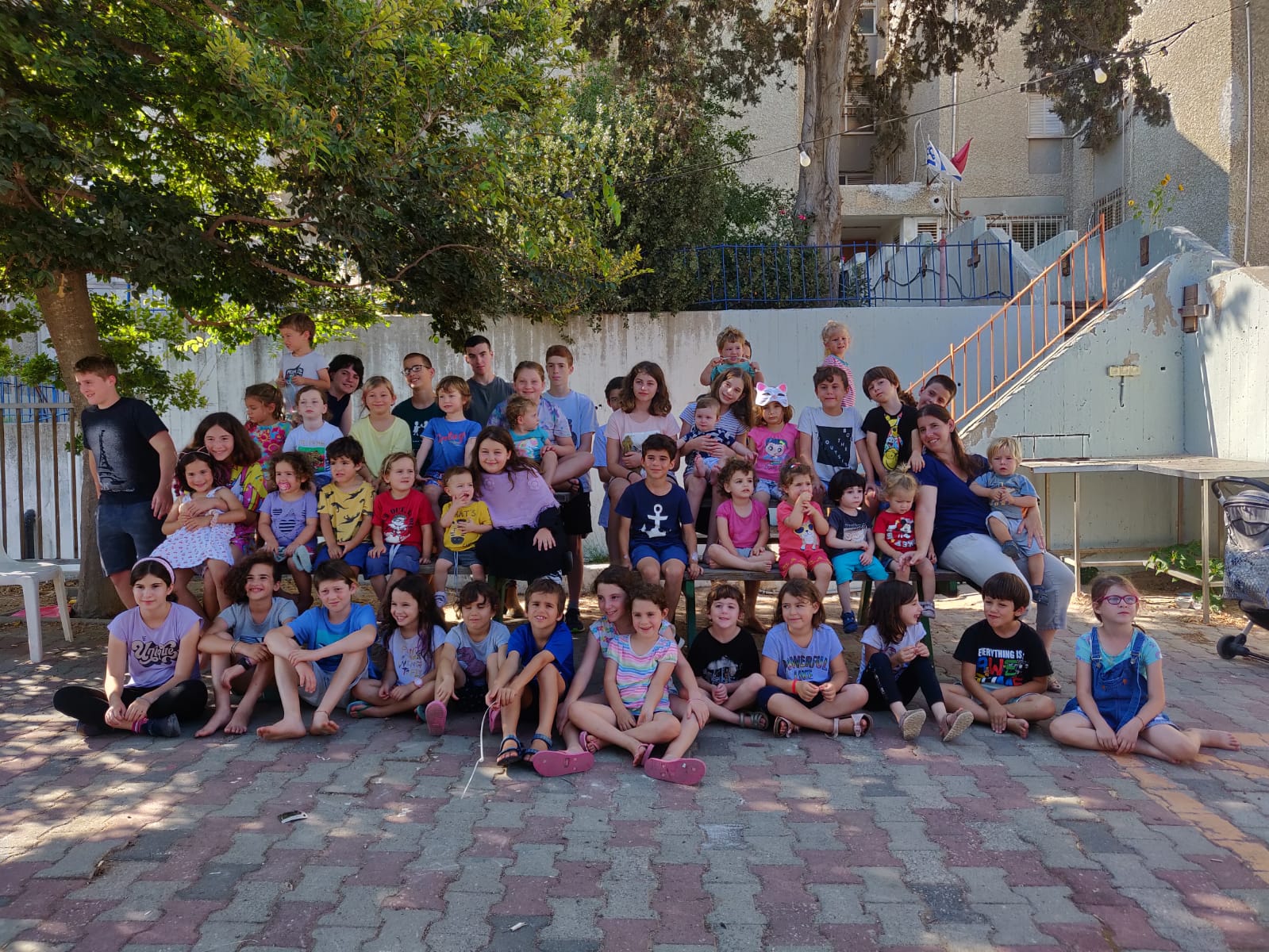
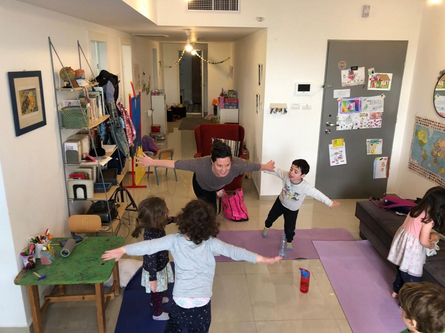
The first baby born into the kibbutz back in 2002 was deemed illustrative of the community’s “serious, long-term intentions”; the birth of the first baby into Yovel four years later similarly represented a milestone for Yovel as a kvutza. External commentators have a tendency to overstate the importance of the “classic” kibbutz attitude to the family (the more extreme communist practices were abandoned very early on, and by the 1970s most kibbutzim had returned to traditional family life), but given the historical lineage of the kibbutz movement, it is nevertheless significant that, in the kibbutz of kvutzot, the family unit is deliberately kept intact. However, across Kibbutz Mish’ol, which by 2007 included thirty children, children are still seen as a communal priority rather than solely a parental responsibility; it is taken as axiomatic that the final decision on any question regarding a child’s upbringing will lie with the parents, but all members of the parents’ kvutza, much like an extension of the immediate family, play an active role in such conversations. The question of children in the community is dealt with, then, on various levels, from an individual and family level to a kvutza and kibbutz level. At the kibbutz level, a team (movilim) is charged with the task of examining the various questions arising from the issue of childrearing, from supporting families through the process of pregnancy and birth to early-years care. Upon the arrival of the first children into the kibbutz, the team developed a general model of norms to address childrearing. Typically, one parent will take maternity or paternity leave (Chofshat leyda, literally “birthing holiday”). The parent, usually the mother, is expected to be back in full-time work and an active member of the community again by the end of the first year, by which time the child is moved fulltime to the kibbutz’s puton (nursery). This timetable is not rigid, and there is no element of compulsion; it is left to the discretion of the individual member, bearing in mind the collectively agreed norms.
In designing its internal education system, the kibbutz considers it imperative to avoid any clash with state education, which begins at the age of four. Mish’ol’s children go into the state system as soon as they are eligible, prior to which they are the responsibility of the kibbutz, whose internal system consists of the puton and the Beit Tinokot (“baby house”). Children’s education is the responsibility of a kibbutz committee called Tzevet Chinuch Yeladeinu (Our Children’s Education Team) or TZACHI, which oversees the running of the puton, the Beit Tinokot, and various other aspects of early-years education. This is considered a vital responsibility and taken extremely seriously. TZACHI’s main task is the development of an educational model consistent with the kibbutz’s value system.
Members charged with coordinating the development of the educational rationale, the specific frameworks of its educational facilities, and the metaplot (the members who work in education) were also raised, for the most part, on kibbutzim and subsequently worked in the kibbutz education systems. When the first children were born into Mish’ol, the established kibbutzim provided the model for the educational rationale, from providing a basis for understanding dilemmas and questions to creating a kibbutz-style educational framework. The kibbutzim’s educational influence can be seen in the emphases on interpersonal relationships between children, on the group, on mutual aid, and on resolving conflicts in an open, verbal manner. The system is directed toward empowering the children, learning through experimentation, and outdoor activities (children go on twice-weekly hikes in the local area). In TZACHI, emphasis is also given to non-hierarchical education; those involved have equal input in, and influence over, decision-making, irrespective of the number of days per week they work or how much responsibility an individual takes on within the team. As one member put it, “whereas in normal playgroups the kids know that there’s someone in charge, that doesn’t exist here.”
- Jewish Tradition
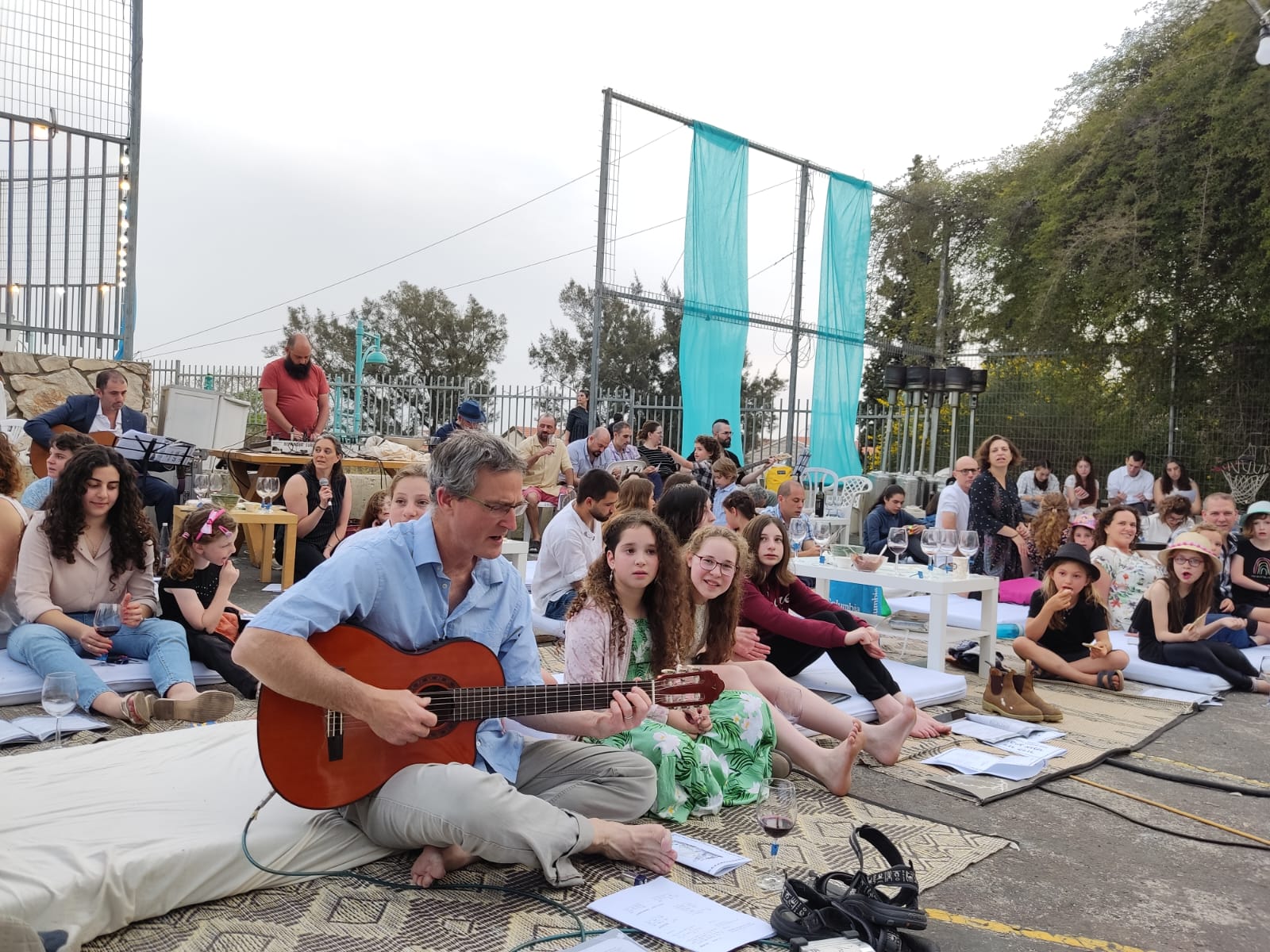
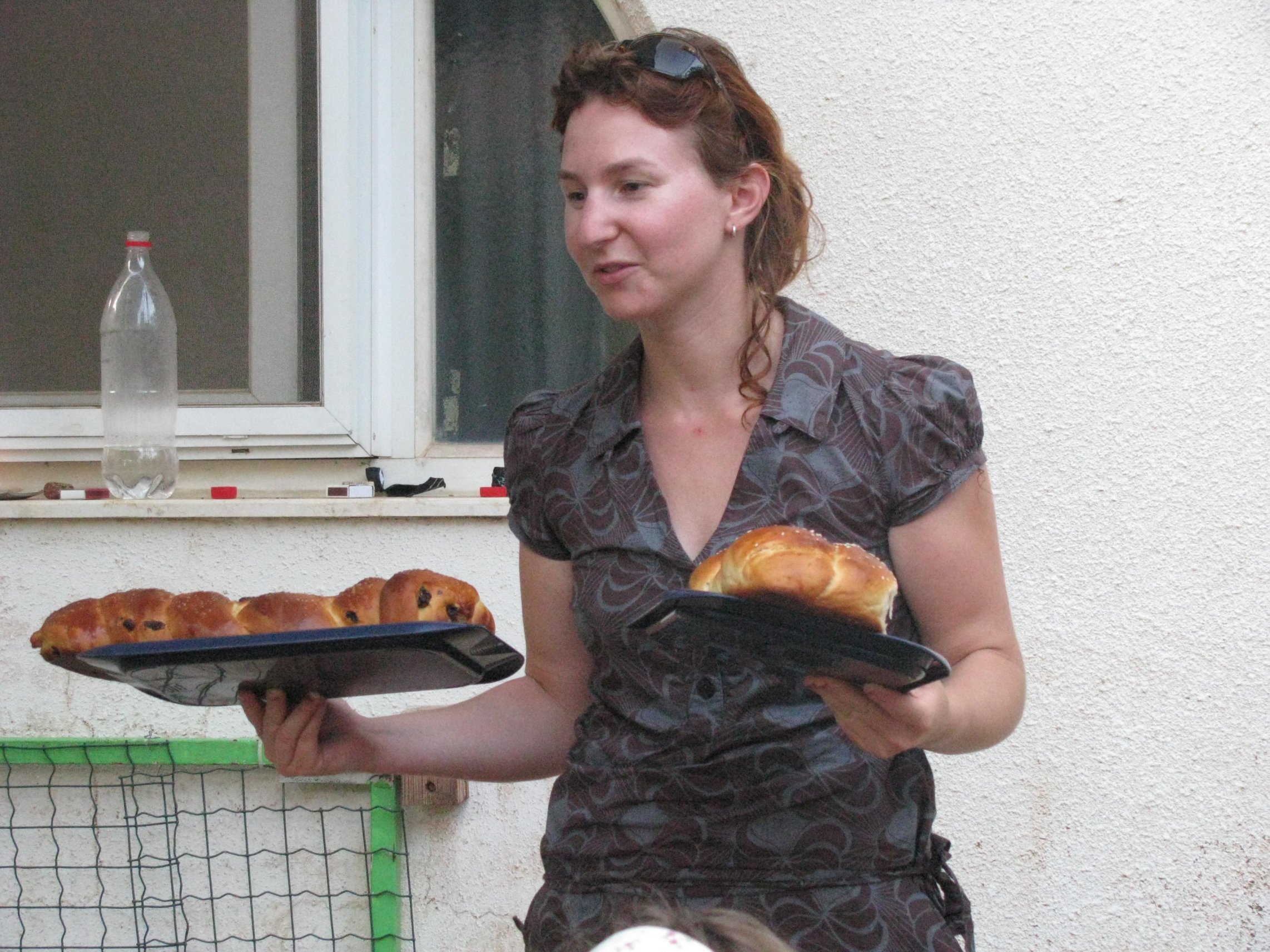
Yovel’s adoption of the traditional kibbutzim’s secular, cultural, humanist interpretation of Judaism is projected onto the plane of everyday life in the community in numerous different ways. In terms of the weekly cycle, the group has built their own unique Kabbalat Shabbat (Friday evening service welcoming the incoming Shabbat), with content drawn from various different sources, which members see above all as a “cultural expression of [their] communal experience.” Shabbat is celebrated as a kvutza, with the group’s “own interpretations, our own words, our own blessings, our own symbols.” On the yearly cycle, Jewish festivals are celebrated “in a cultural, national way,” either as a kvutza and/or as a kibbutz, depending on the festival. New Year, for example, is seen as a time for kvutza introspection, looking back on the year, on “who we are, what we’ve done, why we’ve done it, etc.”; Pesach is celebrated both as a kvutza and as a kibbutz, with a large Seder in which themes of freedom and slavery are discussed and reflected upon. Kibbutz seminars are held on all the major festivals, with the celebrations combined with study and discussion of relevant texts and sources. Lifecycle events (weddings, new births, and so forth) are major celebrations. The form and symbolism of these events reflect the communal ethos of the kibbutz of kvutzot, as both kvutza and kibbutz play large parts. A wedding, for example, might entail a kibbutz gathering with the couple at the center and kvutza members holding the poles of the canopy. Welcoming a baby into the community similarly involves a kibbutz-wide gathering with speeches or readings both by members of the kvutza and by the wider kibbutz community.
External Work
Celebrations of festivals and lifecycle events are important to group life, but members stress that their community’s observance of these events is only one aspect of their interpretation of Judaism. One Yovelnik explains how “for me, everything I do is an expression of my Judaism. This is the same for everyone in the kibbutz. There’s a huge difference between here and the Jewish community in the Diaspora, about what it means to be a Jew. [In moving to Israel] I made a very clear break between that and this.” This attitude reflects a “classic” socialist Zionist view of kibbutz as the natural expression of the imbrication of socialism and Judaism, both a manifestation of Jewish collective life and means and ends of Tikkun Olam (“healing the world”). One of the primary motivations behind the new kibbutz movement—and the reason for the communes’ location in urban settings—is a renewed sense of responsibility to society based on the belief that the kind of “pioneering” necessary in twenty-first-century Israel is of a social nature. During Yovel’s early years in Jerusalem, its messimot (“missions”) centered in large measure on Israeli–Palestinian issues. Members worked at the Palestine-Israel Journal, with the Palestinian Human Rights Monitoring Group, and in joint action coordinated with Bat Shalom, Rabbis for Human Rights, Peace Now, and other organizations aligned with the Peace Camp. When Yovel relocated to Migdal Ha’Emeq, it redirected its focus toward “becoming Israeli” and relinquishing its status as an isolated group of recent immigrants. This change of emphasis was due, in part, simply to being away from Jerusalem and, in part, to the influence of the sabra groups they joined. From this point forward, they invested their energy in social issues in the local area rather than in national headline issues.
All but one of Yovel’s members work in education in some capacity. Historically, their concentration has been divided between Habonim Dror youth movement initiatives (connected to the kvutza rather than the kibbutz) and the projects run by the kibbutz in the local area. Members worked in one or both of these spheres. Initiatives run by the youth movement have included various coexistence projects, conceived as relationship-building exercises based, for example, on teaching English in Arab schools. Habonim Dror members in Israel on shnat sherut (“service year”) programs still undertake these initiatives, but Yovel’s diminishing attachment to Habonim Dror over recent years has resulted in disengagement with youth movement activities and greater involvement in projects operated by Kibbutz Mish’ol in its surroundings.
These projects seek to engage directly with the local neighborhoods and address the immediate needs of the community. Across the youth movement sphere of the communal scene, projects typically include nursery schools, after-school help and enrichment for grades one to four, programs to prevent pupils from dropping out, and help with matriculation exams. Projects also include various “one-off” initiatives such as an ongoing project to integrate Darfurian refugees living on Kibbutz Na’aran in the Jordan Valley, which hosts refugees for activities run by youth movement members during school holidays. A team also operates weekly activities in the schools where refugees live and study, helping to find and guide foster families, working on a political level for the refugees, and so on. In Nazareth Illit, Kibbutz Mish’ol specifically runs three main initiatives: an after school club (Beit Choco, “Chocolate House”), a learning center (Merkaz Tishrei) that provides supplementary education for high school pupils, and a karem center. In Migdal Ha’Emeq, the kibbutz runs a learning center, an after-school club (also called Beit Choco), and a project known as Ya’adim (“objectives”) that engages kibbutz members directly in the local school system.12
Each of the after-school clubs in Migdal Ha’Emeq and Nazareth Illit is attended by about thirty children between the ages of eight and twelve. Run in partnership with the local schools, the centers target children from underprivileged backgrounds and provide a hot meal, help with homework, and a safe place to play. The two centers’ activities differ slightly, each organized according to the wants and needs of those who attend them, but they are united by an emphasis on mediation and relationship building. In instances of conflict, children are counseled to work through and overcome that conflict verbally and calmly. The curriculum centers on constructive activities, experiential education, and “free play,” with various creative arts and crafts activities given special priority. “Rather than jumping on cars and beating each other up” one of the coordinators explains, “the club emphasizes building things together, the operative word being ‘together.’” The same principle governs Ya’adim, the only project the kibbutz runs within Israel’s state education system. Through Ya’adim, kibbutzniks work in local schools as part-time teaching staff, helping students improve their bagrut (matriculation). One aspect of this entails kibbutzniks taking half a class and teaching it using their own methods, the emphasis here again on relationship building between students, and between staff and students. The intention in building relationships between staff and students is to promote teacher perseverance with “difficult” pupils, bring out students’ potential, and “empower” them. This project is expanding in schools in the Nazareth area, as individual schools and the Education Ministry have so far been amenable to kibbutz personnel assuming greater responsibility. These initiatives are unique to Kibbutz Mish’ol, but the nationwide kvutzot movement engages in both mainstream and non-formal education in one way or another. The idea of building their own schools and becoming more entrenched in the state education system is occasionally mentioned by the communards as a long-term goal. While this prospect is seen as being so distant as to not be worth devoting much discussion to at this stage of the kibbutz’s life, the municipality and the Ministry of Education have been supportive of their activities. And as the density of kvutzot in the Migdal Ha’Emeq area has increased, so too has the kibbutz’s optimism toward the impact—and potential future impact—of its work. Outside the education sphere, attempts at further integration of the kibbutz into its environs have been, and are being, made on a neighborhood level. Efforts have been made to establish various neighborhood schemes such as a cooperative project with the parents of the children involved in the kibbutz’s educational projects. Yovel’s first attempt to organize a parents’ group to engage in skill exchanges and other local-level cooperative initiatives met with little success; lack of time and resources prevented sufficient engagement from the local community in the project, and it was shelved within a year. A similar initiative in Nazareth involving the parents of the children of Beit Choco has, members report, had more success. Beit Choco is being used as a focal point, around which to build up a community by encouraging increased parental involvement in, and responsibility for, the running of the center.
- Transformations
Both kvutza and kibbutz of kvutzot are continually changing and developing processes. During the course of the current study, the main changes concerned the demographic expansion of the kvutza and the centralization of Mish’ol’s constituent kvutzot into the kibbutz of kvutzot. Both have entailed significant structural and ontological transformations. The first major change to the kvutza came in July 2006 with the birth of the first baby. The following August, a new member from Habonim Dror Australia (HDOZ) began the process of joining. Around the same time, four sabra Israelis (three adults and a baby, all from a neighboring kvutza, which had recently disintegrated) also began the joining process. By 2009 all were fully integrated into the kvutza. Yovel’s affiliational and ethnic changes likewise hold both practical and symbolic significance. That Yovel now includes four sabra Israelis represents a milestone in the group’s absorption into Israel. Kvutza life is now lived entirely in Hebrew, and the group’s culture is regarded as being “far more ‘kibbutznik,’” as all the new members are bnei meshek (originally from Kibbutz Rosh Hanikra, Kibbutz Bet Ha’Emek, and Kibbutz Be’eri). Moreover, having been a Habonim Dror kvutza for a decade, Yovel now for the first time includes members from different youth movements. The new members grew up in NOAL and Kvutsot HaBechira before merging with HaMachanot HaOlim. The significance of this development can be grasped in the context of Yovel’s decision to take full membership in the kibbutz, which now makes them members of the Tnuat Bogrim of Machanot HaOlim rather than Habonim Dror. This new reality resolves an underlying tension over Yovel’s status and identity, as the merger was seen as a clear step out of Habonim Dror and into the kibbutz. By 2009 two Yovelniks had ended their involvement in Habonim Dror projects altogether, meaning that they are no longer connected to, or receiving salaries from, the youth movement. By the autumn of 2010, only one member was still involved in Habonim Dror activities.
These developments in Yovel attest to the group’s entrenchment and stability as a permanent kvutza and its integration into HaMachanot HaOlim and Kibbutz Mish’ol. Indeed, general trends over the last decade point to integration, both on a micro level for Yovel as a kvutza, as summarized above, and on a macro level in the transformation of the kibbutz of kvutzot as a whole. In terms of generalizing beyond the particular case of Yovel and Mish’ol, this latter point exemplifies a process that has been seen across Israel’s kibbutzim of kvutzot during this period.
When Yovel arrived in Migdal Ha’Emeq in 2002, the individual kvutzot of what would become Kibbutz Mish’ol were essentially discrete, autonomous entities. Over the following years it became evident that the clusters of kvutzot in Migdal Ha’Emeq and Nazareth Illit effectively existed as a single community, irrespective of the geographical divide and regardless of the fact that not all were part of the kibbutz’s financial cooperation structure. A communal carpool, cultural celebrations, meetings, seminars, and other shared activities were felt to bind the two clusters into one community. Since 2003 the kibbutz has been engaged in formally bringing these groups together into its unified institutional framework.
Integral to this process is the fusion of community and meshek, a kibbutz-wide organizational framework, including a communal work structure based on cross-kvutza work teams. Prior to universal financial cooperation in 2007 to 2008, with member kvutzot living as discrete bodies and responsible in large measure for their own affairs, those spheres were largely separate. In practice this meant that some people worked alongside one another in a cooperative work structure and received equal living allowances, while sharing a kvutza with others in external employment. In 2007 it was decided that this “half-and-half” status quo, with some people “in” and others “out,” was conducive to economic inequality and therefore untenable. The step to join the financial cooperation and work cooperation, integrating community and meshek, means that, while there are still kibbutz members in outside employment, their income goes into the kibbutz, making all members part of the same economic system and on the same financial footing.
Members describe the transformations of inter-kvutza relationships and relations between the kvutzot and the larger structure of the kibbutz that the process of building the kibbutz has entailed as “a constant tightrope.” “How much can we build a kibbutz which brings us together without destroying the kvutzot, and how much can we maintain the kvutzot without destroying this process of building the kibbutz?” The priority in bringing the kibbutz of kvutzot into being has been working out how best to strike this balance. “When you strengthen the kibbutz you weaken the kvutzot,” says one member, “and when you strengthen the kvutzot you weaken the kibbutz. It’s not easy doing both at the same time, because they’re both just as important.” So far it has been clearer how to strengthen the kibbutz, as might be expected given that most of those involved come from a kibbutz background. The organizational framework of the meshek that forms the structural basis for the kibbutz is seen as something that can be expanded on and can accommodate increasing numbers of people. Given the robustness of this structure, and given what members perceive as their success in using it as a foundation for the kibbutz, the emphasis in current discussions is on how to strengthen the kvutzot within the kibbutz. A committee meets on a weekly basis to examine the best way for the kibbutz of kvutzot to establish a desirable balance between autonomy and cooperation. There are various different aspects to this question, ranging from the community’s cultural life (for example, how festivals and lifecycle events are celebrated) to spacerelated issues (for example, whether or not to establish a central office and meeting rooms) to coordinating the practical side of shared responsibility for the community’s children (for example, whether or not each group should have different erev kvutza for babysitting purposes) to communal work arrangements (for example, projects, financial questions, and so forth).
The fundamental understanding that this new creation must not be “just a kibbutz” but a “kibbutz of kvutzot” guides these discussions. The advantages of being an independent kvutza are certainly recognized, but it is also felt that the absence of a wider framework limits the impact and influence a single kvutza is able to exert on its environs. It is also argued that the kvutza’s small size precludes it from being able to address all human needs and necessitates membership of a wider framework. But as one member elaborates, “you’re then faced with the question of what that wider framework should look like. As soon as you accept the need to be part of that wider framework, then you start giving attention to questions like, how much do I need to relinquish a certain level of autonomy, and how can I avoid becoming the old kibbutz? And how can I embrace that wider framework?”
Over the course of dozens of conversations with kibbutz members since 2006, one ongoing trend is a gradual but noticeable shift in emphasis away from the kvutza and onto the kibbutz. Particularly between 2007 and 2009, the concept of the kibbutz of kvutzot became markedly more significant. When Yovelniks say “we,” the term no longer always denotes an individual kvutza but often one hundred people across Nazareth Illit and Migdal Ha’Emeq. Nevertheless, members are confident that the community has remained mindful that it is a kibbutz of kvutzot, rather than a kibbutz. Indeed, the potential for the kvutza to be subsumed in the larger structure is something of which they are almost pathologically conscious. “We’re convinced that if the kvutza disintegrates as a meaningful entity,” says one Yovelnik, “then we will no longer exist. We fail.”
- I and Thou
In a previous article on Israel’s urban communes, I noted the correspondence between the new kibbutz and the genus of community defined by Rosabeth Moss Kanter as “service communes.”13 Rather than simply aiming to create a more desirable way of life for its members, the community is directed outward. It views itself as creating the infrastructure of a new order by providing an environment in which its members feel able to develop their own individual potentialities, and, at the same time, as an urban base from which to engage in external social action in its surroundings.14 Like all the groups in the youth movement sector of Israel’s new communal scene, Yovel and Mish’ol thus consider themselves a continuation of the “synthesis between social struggle and socialist construction” that has historically been the defining feature of the Israeli labor movement. 15 This fusion of everyday social action and the creation of, and participation in, a new societal structure is a defining feature of both old and new kibbutz. The new communes’ location in urban settings facilitates involvement in their environs in a way that their predecessors had, by the late 1950s, found themselves ill-equipped and often unwilling to manage.
The service adaptation, which provides a focal point in the form of an external mission around which to cohere, has an impact on the commune’s internal character. External interactions bolster the binding sense of mission, enhancing cohesion by producing strong boundaries and commitment from members. The community is strong and tightknit, and, consistent with Kanter’s summation of this genus of communalism, the limitations it imposes on its members are numerous. The community defines behavioral norms to which all members are expected to adhere, and is not hesitant to develop organization, structure, and rules. 16 The belief systems, value-sets, and ideologies developed in the community, and beforehand in the youth movement, which govern community life, are elaborate, and observance is expected. Boundaries are clearly defined, stemming from a clear central purpose that gives focus and provides a reading grid to differentiate between acceptable and unacceptable behaviors. The external mission contributes to the establishment of criteria for decision-making and potentially justifies the move toward a relatively “closed” society17 in the sense that, to become a permanent member, an outsider must be formally admitted and explicitly defined as being “in.” (The main criterion for absorption is youth movement membership, deemed essential for the maintenance of community cohesion.) Thus, with some exceptions (such as the absorption of two Eritrean refugee children whom Yovel has “semi-adopted”), the commune maintains a clear divide membership-wise between itself and its constituency.
While aspects of Kanter’s critique thus provide an applicable frame of reference, the rather authoritarian picture she paints of the “service commune” demands some qualification. Mish’ol’s decision-making processes have been referred to throughout this article in the language of “direct democracy” and “consensus” (these are the terms members use), and such terms are not inappropriate in characterizing the kibbutz’s institutions. Perhaps more expressive, however, is the terminology of isonomy in the particular sense in which Hannah Arendt employs the term. 18 Describing a communal life lived under “conditions of no-rule, without a division between rulers and ruled,” 19 isonomy is axiologically divergent from democracy in its resistance to majoritarian governance. Equality and freedom are not mutually exclusive here, but synonymous, the equality of isonomy that of “those who form a body of peers.” 20 We might further suggest the term “isocracy,” which comes from the Greek words “ισος,” meaning “equal,” and κρατειν, meaning “to have power.” The expansion of this notion evokes the original meaning of isonomy more strongly than does the latter term in its current usage. The political culture expressed in the new kibbutz governance model establishes a framework of free deliberation among equals—free in that participants consider themselves bound solely by the results and preconditions of the deliberation (and are not subject to any external authority, either of a priori norms or of coercive enforcement mechanisms) and in that they see the decision’s origin in universal deliberation as sufficient reason for compliance. Participants are equal, both in a formal sense (any member can put forward proposals and veto and support measures with no formal hierarchies either at kvutza or kibbutz levels) and in a substantive sense (they are not limited by particular distributions of power, resources, or pre-existing norms). Only when consensus proves impossible is majority decision-making deployed. Even then, each member has by that point contributed significantly to formulating the substance of the choices.
For many kibbutz children of the 1950s, 1960s, and 1970s, the connotations of the term “equality” were predominantly negative. In part because of this negative connotation, the new kibbutz is based in the values of shituf rather than in the classic kibbutz desire for “equality.” Shituf (or shituf pe’ula, meaning “cooperation in work”; that is, partnership) denotes a communalism that seeks to reconcile individual sovereignty with social responsibility in a community framework built on I-Thou relationships.21 Its dynamic negates regularization in that the group so organized does not— and theoretically cannot—assume a life of its own above and beyond its individual members. This communal ethic actively resists the emergence of such a dynamic by constantly interrogating from below any attempt to impose structure from above. The solidarity of the group is, in Durkheim’s terminology, “mechanical,” in that it derives from the homogeneity of individuals and is maintained via shared educational backgrounds and ongoing communal learning processes. Yet it is a group dynamic that enables face-to-face relationships and the spontaneity and reciprocity of such relationships possible in small social units as a stable foundation for the flourishing of camaraderie, friendship, and mutual aid. Community life rests in a set of shared values and ideas (“vision”), which creates an “inner code” conducive to the individual feeling comfortable within a particular social framework that does not assume its own autonomous existence above, beyond, or inimical to its creators.22
All of this combines into a dialogical communalism, in a Buberian sense, reminiscent—in its attempt to reconcile socialist communalism with individual self-determination—of the seidlung (settlement) depicted by Gustav Landauer. Moreover, built into the community’s structural design are various safeguards explicitly designed to obviate the emergence of the institutional monoliths that contributed to the original kibbutzim’s eventual failure to approximate this same ideal. Maximum dispersal of deliberative agency in the kibbutz-level decision-making system, for instance, is seen as actively subverting the centralization of political power and the formation of a kibbutz establishment. Relying on direct participation in all areas of daily life and engagement of all members in the decision-making process, the collective remains the ultimate authority of community governance. However, it eschews of the notion of the General Assembly as the central democratic institution, instead spreading kibbutz politics across the variety of diffuse consulting and executive groups that constitute the decision-making centers. Therefore, sovereignty lies literally with the citizenry. Retention of the kvutza as the primary communal unit, together with the intimacy and visibility of community relations at both kvutza and kibbutz levels, economic equality, direct democracy, and the absence of wage differentials combine to subvert the centralization of power, stratification, and the emergence of formal elites. The role of committees is coordinative and executive rather than definitive, and the role of office-holders is organizational rather than coercive. Participatory decision-making procedures ensure that it is the community at large which defines, decides, and scrutinizes policy for the committees. Communal learning acts to ward off the emergence of knowledge elites, and family, kvutza, and kibbutz operate simultaneously in a mutually complementary fashion so as to prevent, in theory, the collective’s control over the individual from becoming “total.” 23
- Conclusion
It is important to reiterate that the kibbutz of kvutzot is not conceived as a static, one-off community, but rather as part of a larger social force with directional motion. Prevalent in Habonim Dror literature is the conjunction of “movement” (defined as an association of persons working to change the way things are into the way they think they should be) and “organization” (the functional structural frameworks that arise from this association and through which a “vision” is brought into existence). The “vital force” is the movement—“the life force inside the structural frameworks.” 24 This interpretation again harks back to Buber and Landauer. In the new kibbutz, as in the kvutzot of the 1920s and 1930s—whose founders arrived in Palestine inspired, in many cases, by these thinkers’ ideas—the emphasis is on the movement. In part for this reason, community life is orientated toward the Gemeinschaftliche: the affective, affiliative, expressive aspects of social existence. 25 Instrumental, task-oriented questions are subaltern to the impulse to preserve the group’s Gemeinschaft character (again, the retention of the kvutza as the primary social unit is seen as crucial in ensuring this). Accordingly, decisions tend to be made on the basis of communal, rather than organizational, considerations. The community’s physical base in rented housing, for example, has been the source of constant debate, with its implications discussed at length both in terms of financial considerations and in terms of overall movement goals. The various available options, however, have been chiefly examined in terms of how each would affect members’ overall quality of life, as well as the impact of each on the aims and ideals of socialist Zionist pioneering. Such considerations, rather than business interests, tend to be the primary criteria for decision-making. 26 Similarly, an awareness of potential long-term problems of reliance on government grants has not tended to be a prominent factor in decision-making about means of production. The question of members in outside employment is viewed not chiefly in terms of its economic ramifications, nor even in terms of its impact on the aims of the movement, but primarily in terms of personal freedom and individual fulfillment. Their rationale is that commitment to diversity and respect for individuals’ wishes and desires are at least as important as the communal mission.
The term “kvutza,” in short, refers to a process of dialogue. When members speak of “building” kvutzot, “building” means talking, discussing, cultivating relationships, and reaching understandings and consensus. As with the youth movement kvutzot of the early twentieth century, emphasis in the kibbutzim of kvutzot is on expressive, affective, value-oriented, personally directed relations that issue from close emotional ties and personal investment of participants. Their predecessors’ fusion of commitment to consensus with an “ideological collectivism,” considered a framework for “ideological action and discussion,” 27 continues in the new kibbutzim, but the new kibbutzim purport to reconcile the pursuit of consensus with a thoroughgoing commitment to pluralism and individual self-determination. “The main thing,” as one member puts it, “is that we share a lot more than we disagree on. That thing that we share can be encapsulated in one word, and that’s ‘vision.’ Kvutza is the dialogue into how to get closer to that vision. We don’t have the answers to most of the questions that we have to face, but the important thing is that we’re asking the questions, and that we’re exploring the answers together.”
______________________________________________________________________________________________________________________________________________________
Footnotes
1 The Habonim Dror communes in Israel consist of immigrants from the United Kingdom, the United States, Mexico, Australia, and Brazil. As of 2010 there are three stable Habonim Dror groups: Ogen, based in Hadera, with a total of five members; Aseef, in Netanya, with eight members; and Yovel, in Migdal Ha’Emeq.
2 Though the Kibbutz of Kvutzot is not an entirely urban phenomenon (the “educational kibbutzim” Ravid, Eshbal, Hanaton, Na’aran, and Pelech are located in rural settings), most are situated in urban areas. For some background on the character and early development of the urban commune idea, see James Horrox, “City Communes in Israel: Prolegomena to a Morphology of Urban Communalism,” Communal Societies 31, no. 2 (Autumn 2011): 21–44.
3 The foundations of Kibbutz Mish’ol were laid during the late 1990s by alumni of Kvutzot HaBechira, at that time part of the Ha’noar Ha’oved youth movement. Internal ideological differences subsequently led to HaBechira splitting from Ha’noar Ha’oved and merging with HaMachanot HaOlim, making the kibbutz they were building part of the national network of HaMachanot HaOlim. Mish’ol, which for a while went under the name of Kibbutz Na’ama, only solidified as a kibbutz some time after Yovel joined (the term itself was not used until the late 2000s).
4 See Horrox, “City Communes in Israel.”
5 At the outset of the current research, scholarly literature on the new Israeli communes was scarce, but in the period during and after which the fieldwork for this article took place, several major studies have been published in Hebrew. See in particular Yuval Dror, ed., Communal Groups in Israel (Efal, Israel: Yad Tabenkin, 2008), which contains a chapter by Nir Michaeli and Daniel Rosolio on Yovel, specifically (“To Do Something Great Together: Committed Communality in the Groups in Migdal Haemek and Upper Nazareth,” 438–74). English-language literature remains scarce, but Dror’s anthology includes an English abstract, as does Nir Michaeli’s Ph.D. dissertation, “People for Tomorrow: The New Israeli Communal Groups– Intentional Communities or Signs of Labor Movement Revival” (Tel Aviv University, 2007), which looks at the communities’ educational practices. A number of papers by Michaeli (notably, “The New Israeli Communal Groups–Intentional Communities Establishers or Labor Movement Revivers?” presented at the International Communal Studies Association Conference at Damanhur, Italy, in 2007) are available in English, and a study by Yuval Dror titled “The New Communal Groups in Israel: Urban Kibbutzim and Groups of Youth Movement Graduates,” in One Hundred Years of Kibbutz Life, A Century of Crises and Reinvention, ed. Michal Palgi and Shulamit Reinharz (New Brunswick, N.J.: Transaction, 2011), 315–24, likewise provides English-language analysis of the communes.
6 Unless otherwise stated, all direct quotations in this article are taken from face-to-face interviews conducted by the author with members of Kibbutz Mish’ol between 2006 and 2011.
7 At the time of the last interviews for this research, the makom process was in its fifth year.
8 Avraham Pavin, “The Governmental System of the Kibbutz,” in Crisis in the Israeli Kibbutz: Meeting the Challenge of Changing Times, ed. Uri Leviatan, Hugh Oliver, and Jack Quarter (London: Praeger, 1998), 100.
9 That is, debates in the 1910s, 1920s, and 1930s between proponents of the “big kvutza,” organized around Yitzhak Tabenkin, Shlomo Lavi, and the Gedud HaAvoda (which in 1924 became the Kibbutz Hameuhad federation) and advocates of the intimate kvutza idea, including A. D. Gordon, the Second Aliya kvutzot (which in 1925 became Hever HaKvutzot [Association of Kvutzot]), and the Hashomer Hatzair groups of the early 1920s.
10 Compare, Joseph Blasi, The Communal Experience of the Kibbutz (New Brunswick, N.J.: Transaction, 1986), 100; and Christopher Warhurst, Between Market, State, and Kibbutz: The Management and Transformation of Socialist Industry (London: Mansell, 1999).
11 In Yovel’s early days it was not unusual for its members to be involved in the internal structure of Habonim Dror in addition to external employment. The norm was for every member to follow his or her own path (as is the case in the Urban Kibbutzim. See my article, “From the Frontlines,” Communities At Large Letter [April 2008]: 19–21). As members found themselves becoming increasingly involved in Habonim and the kvutza became more selfsupporting, one of their number found that he remained in the same position. Following Yovel’s relocation in 2003, the member in question worked in one of the kvutza’s educational projects for a while before deciding that it was not for him. He then worked in three companies before finally settling into Carmel Olefins Ltd., where he works in the company’s production and management center in the Haifa Bay industrial zone. Debates have been had in all the kvutzot over the implications of members in outside employment. In other youth movements (particularly Ha’noar Ha’oved, which has historically been relatively intransigent on this issue), the choice to work outside of kibbutz projects would be unacceptable. It is worth noting that the structure of the kibbutz of kvutzot ensures that no members choosing to work externally have any economic motivation for doing so since their income goes into the kupah and thus benefits the group rather than just the individual.
12 For analysis of the communities’ educational activities and the pedagogical approaches employed in both their internal and external educational work, see, for example, Michaeli, “People for Tomorrow,” and “The New Israeli Communal Groups.” Michaeli identifies several components to their “political-ideological educational approach,” which, he argues, combine to form a “pioneering and innovative” pedagogical framework: “camaraderie and eye-level contact with partners and youth group members; practicing a large variety of activities in multiple domains; educators’ political and social task-orientedness and commitment to make it present in activities; establishing long-term, large-scale educational processes, fostering an informal organizational culture; viewing ‘informality’ as an alternative conception of learning and striving to extend it beyond the informal frameworks.” Seeking a theory to conceptualize the combination, in the groups’ educational task-orientated approach, of commitment to social values (justice, solidarity, nationality) and critical and political dimensions, Michaeli suggests the concept of Social Pedagogy: a “conception of teaching that blurs dichotomies prevalent in educational research and practice: between teaching and education, between formal and informal education and between the dimensions of organization and of content in the system” (ibid.). This conception, Michaeli argues, offers an apposite “middle road between ideological (indoctrinational) education and political (neutral) education, posits ‘learning through doing’ as a central path and turns the learners into active, creative participants and the teachers into mentors with a purpose and political orientation” (Michaeli, “The New Israeli Communal Groups,” 7).
13 Rosabeth Moss Kanter, Commitment and Community: Communes and Utopias in Sociological Perspective (Cambridge, Mass.: Harvard University Press, 1972), chapter 8.
14 Andrew Rigby, Alternative Realities: A Study of Communes and Their Members (London: Routledge and Kegan Paul, 1974), 8, 102.
15 Yehuda Yudin, “Industrial Democracy as a Component of Social Change: The Israeli Approach and Experience,” in Self-management: New Dimensions To Democracy, ed. Ichak Adizes and Elisabeth Mann Borgese (Santa Barbara, Calif.: ABC-CLIO, 1975), 72–73.
16 Kanter, Commitment and Community, 200–201.
17 Kanter, Commitment and Community, 195.
18 Hannah Arendt, On Revolution (1963; London: Penguin, 1990), 30.
19 Arendt, On Revolution, 30.
20 Arendt, On Revolution, 30.
21 Martin Buber, I and Thou (1923; London: Continuum, 2004).
22 Compare, Avraham Yassour, “Gustav Landauer: The Man, the Jew, and the Anarchist,” Ya’ad no. 2 (1989), http://www.waste.org/~roadrunner/ScarletLetterArchives/Landauer/Yassour_Gustav_Landauer .htm, 18.
23 One recalls Landauer’s view of a marriage, “in which two people complement one another to the highest point of productiveness,” as the prototype of any worthwhile community and the foundation on which human beings, solidarity, and community should be rebuilt. “My wife and my children—my world! On this feeling, on this exclusive belonging together, on this natural community, I wish all the larger cooperatives, in the first place the community . . . , to be built up” (quoted in Julius Bab, Gustav Landauer: Commemorative Speech Given by Julius Bab at the People’s Hall in Berlin on the 25th of May, 1919 [Berlin: Paul Cassirer Verlag, 1919]). (Quotation from an unpublished English translation by A. Mason and M. Hindley, n.d.) In a presentation to the 2007 International Communal Societies Association conference, Nir Michaeli suggested that the new Israeli communes “realize . . . the communal anarchist current of socialist thought—the village or collective farm a la Gustav Landauer or Martin Buber’s Hevruta, translated into a reality of communal living” (“The New Israeli Communal Groups,” 6). For background and analysis of Landauer’s influence on the kibbutz movement, see inter alia Avraham Yassour, ed., Gustav Landauer on Communal Settlement and Its Industrialization (Haifa: University of Haifa, n.d.); Ruth Link-Salinger Hyman, Gustav Landauer: Philosopher of Utopia (Indianapolis, Ind.: Hackett, 1977). For his relevance to communal societies generally and the kibbutz/new kibbutz specifically, see Mike Tyldesley, No Heavenly Delusion? A Comparative Study of Three Communal Movements (Liverpool: Liverpool University Press, 2003).
24 Zohar Michaeli, Letter to HDOZ shnat group 1999, www.habonimdror.org.il/booklet/15.%20letter%20to%20oz99.doc (accessed September 20, 2010).
25 Buber, I and Thou, 39.
26 Throughout the duration of this research, Yovel was discussing whether to stay in Migdal Ha’Emeq or move to Nazareth Illit. In summer 2009 the kibbutz was offered a disused absorption center in Nazareth Illit on a ten-year rental contract. At the time the last interviews for this study took place, this was seen as an attractive option, enabling all members to be living in closer proximity with one another while remaining in an urban area. Increasingly prominent in the kibbutz’s vocabulary throughout 2009 was the term “tabam,” loosely translated as “it depends on the place.” For example, “We’re going to set up a school tabam—it depends what happens about finding a permanent place. Then we’ll figure out what to do about it.”
27 Tyldesley, No Heavenly Delusion? 129.
James Horrox is an Associate Lecturer in Social Sciences at The Open University.
Follow Us
Most Popular